×

The Standard e-Paper
Kenya’s Boldest Voice
 The Standard Group Plc is a
multi-media organization with investments in media platforms spanning newspaper
print operations, television, radio broadcasting, digital and online services. The
Standard Group is recognized as a leading multi-media house in Kenya with a key
influence in matters of national and international interest.
The Standard Group Plc is a
multi-media organization with investments in media platforms spanning newspaper
print operations, television, radio broadcasting, digital and online services. The
Standard Group is recognized as a leading multi-media house in Kenya with a key
influence in matters of national and international interest.

Audio By Vocalize
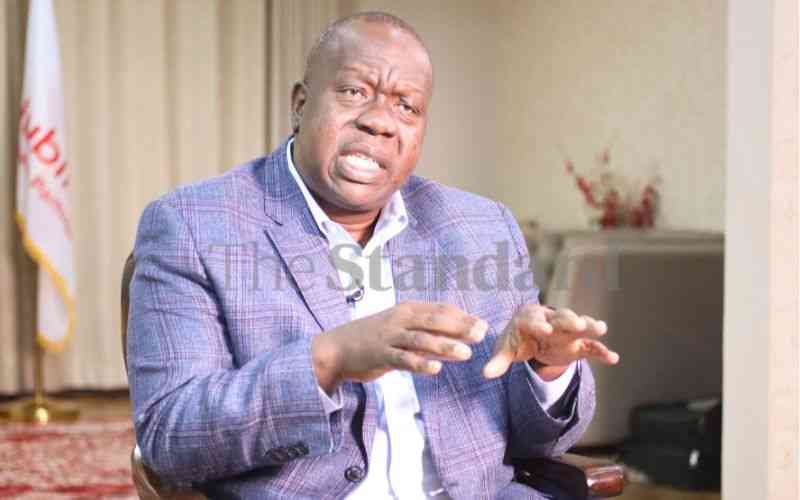
Jubilee Party presidential candidate Fred Matiang’i has signaled he is ready to support a consensus opposition flag bearer in the 2027 General Election, saying the coalition's mission goes beyond removing President William Ruto from office and must focus on fixing what he described as deep governance failures under the current administration.
Speaking during an interview with The Standard, Matiang’i said the opposition coalition should be guided by a shared vision for the country rather than individual political ambitions, insisting that leadership should be determined by who is best placed to deliver change for Kenyans.
“Unseating President William Ruto is not our only agenda. That is only part of a much bigger conversation about the future of this country,” Matiang’i said.
The former Interior Cabinet Secretary said Kenya's problems stem not from a lack of laws or policy frameworks but from weak enforcement, political interference, and the gradual erosion of public institutions.
According to him, the opposition must offer Kenyans a credible alternative anchored on accountability, professionalism, and competent leadership.
“The coalition process is delicate. It takes time. Restraint is part of the strategy of enabling the coalition to be born and come to life,” he said.
His remarks come as opposition leaders continue consultations aimed at forming a united front to challenge Ruto in 2027, with several presidential hopefuls expected to seek a place in the coalition's leadership structure.
Matiang’i indicated that he would be willing to support whoever emerges as the coalition's preferred candidate if the process is fair and focused on the country's interests.
“Leadership is not about individuals. It is about what is delivered to the people,” he said.
Beyond coalition politics, Matiang’i launched a sharp attack on the government's economic management, linking the public anger witnessed during last year's anti-Finance Bill protests to what he termed a growing disconnect between government and citizens.
He argued that Kenyans are being subjected to increasing tax burdens while seeing little improvement in service delivery or accountability in the use of public resources.
“The problem is not that Kenyans are unwilling to pay taxes. The problem is that they do not see accountability and value for the money they are already paying,” he said.
According to Matiang’i, the Finance Bill debate reflects a wider frustration among citizens who feel that the government is demanding more sacrifices from taxpayers while failing to address waste, corruption, and inefficiency.
He said any future administration must prioritise prudent management of public resources, job creation, and economic recovery instead of relying heavily on taxation.
“Our responsibility is to present a credible alternative that addresses the economic pain Kenyans are experiencing. Leadership is not about imposing more burdens on citizens. It is about managing public resources responsibly and delivering results,” he said.
Stay informed. Subscribe to our newsletter
Matiang’i reserved some of his strongest criticism for the security sector, accusing the government of undermining professionalism through politically motivated appointments.
He claimed that competence had increasingly been sacrificed in favour of loyalty and ethnic considerations, weakening the effectiveness of security institutions.
“When appointments reflect political loyalty and ethnic calculation rather than merit, you weaken the system from the top. Some of the people put in security positions heading counties and regions are people I could never imagine in such positions because of their incompetence, but here we have a government that just dishes out appointments because you are from a certain tribe,” he said.
The former Interior minister argued that effective security management depends on constant supervision and direct engagement with officers on the ground, warning that weakened oversight had contributed to rising insecurity and the emergence of organised criminal groups.
“If you have no contact with your service point, you are not doing what is expected of you, and that contact is what is weakening the security structure,” he said.
As negotiations within the opposition continue, Matiang’i's remarks position him as both a potential presidential contender and a key voice pushing for a united opposition movement.
“Unseating Ruto is not our only agenda. Our agenda is to rebuild institutions, restore accountability, protect livelihoods, and ensure that government works for the people, not the other way around,” Matiang’i said.




Subscribe to our newsletter and stay updated on the latest developments and special offers!







 join
join